

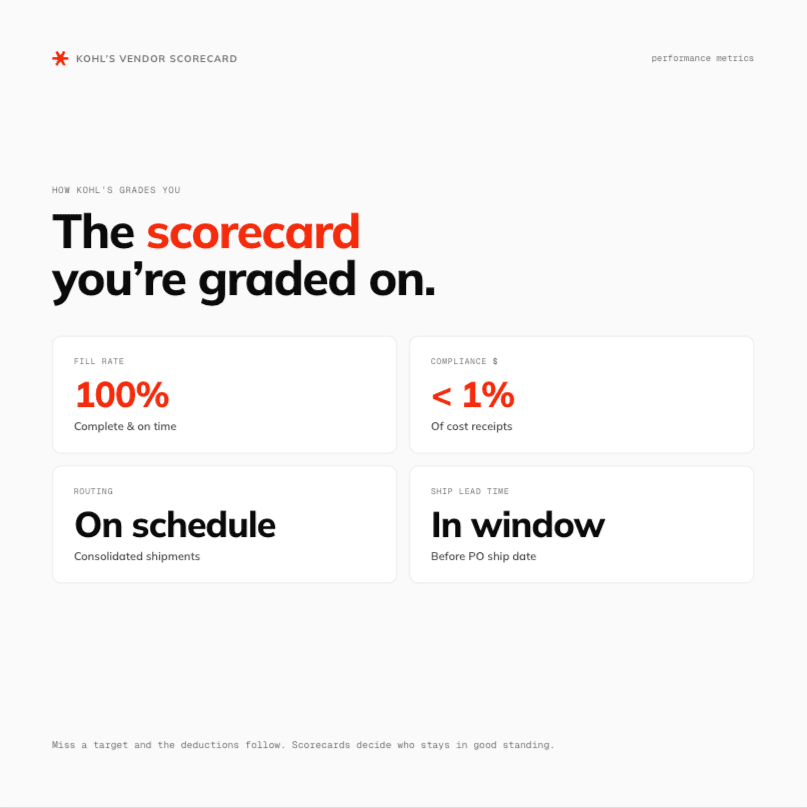
Kohl's requires suppliers to support six to seven core EDI transaction sets for dropship vendors. Kohl's tracks compliance through vendor scorecards covering fill rate, compliance dollars, routing frequency, and shipment lead time. The most common chargeback triggers are late or missing ASNs, invoice/PO mismatches, unapproved split shipments, and routing violations.
One goal that suppliers often aim for is to bring on Kohl’s as a trading partner. The retailer's reach and size open the door to a wide market of potential customers and a substantial revenue stream. However, Kohl's has strict EDI (electronic data interchange) requirements for suppliers that sell through its retail network relating to document formats, shipping timelines, and transaction data accuracy across orders, invoices, and fulfillment updates. Even small errors can lead to lengthy onboarding timelines and non-compliance issues.
For vendors managing high order volumes or selling through multiple retail channels, staying compliant with Kohl’s vendor EDI compliance standards can quickly become a resource-intensive process. Requirements may differ between wholesale and dropship programs, and Kohl's closely monitors performance through scorecards and automated validation checks.
This article explains Kohl’s expectations for suppliers in 2026 and how a modern data interchange solution can prepare your operation for EDI readiness.
What EDI Documents Does Kohl's Require?
Kohl’s suppliers are expected to exchange several electronic business documents in a standardized format throughout the order fulfillment lifecycle. These documents help Kohl’s manage operational and financial workflows across its supply chain. Vendors that fail to submit accurate or timely EDI files may encounter onboarding delays, shipment issues, or costly chargebacks for failing compliance.
While EDI standards can vary by vendor relationship and fulfillment model, most suppliers working with Kohl’s will need to support a core group of transaction sets.
Required Transaction Sets
The following Kohl’s EDI documents are commonly required for supplier onboarding and ongoing operations:
EDI 850 Purchase Order: The 850 purchase order communicates purchase orders from Kohl’s to the supplier, including product quantities, pricing, ship dates, and fulfillment instructions.
EDI 855 Purchase Order Acknowledgment: The 855 acknowledgment confirms that the supplier has received and accepted the order details or identifies requested changes or exceptions.
EDI 856 Advance Ship Notice (ASN): The 856 EDI document provides shipment details before goods arrive at the destination. Accurate ASN submission helps Kohl’s prepare receiving operations and reconcile inbound shipments.
EDI 810 Invoice: The 810 invoice communicates billing information tied to shipped goods and is used during payment reconciliation and matching workflows.
EDI 820 Remittance Advice: The 820 document provides payment and remittance details associated with completed transactions between Kohl’s and the supplier.
EDI 997 Functional Acknowledgment: The 997 confirms that the receiving system successfully received and processed the EDI documents.
EDI 846 Inventory Inquiry/Advice: Kohl’s dropship vendors may also need to support the 846 transaction set to provide inventory updates and maintain accurate product availability data.
Dropship vs. Wholesale: Where the Requirements Differ
Wholesale and dropship suppliers often face different fulfillment expectations. Wholesale vendors typically ship inventory to Kohl’s distribution centers according to routing requirements and scheduled replenishment processes.
Dropship suppliers usually ship directly to customers after receiving retailer order data. Because of this, Kohl’s may require more frequent inventory updates through the EDI 846 transaction set to help prevent overselling and inventory discrepancies.
Routing, shipping timelines, labeling standards, and fulfillment visibility requirements may also differ between wholesale and dropship operations, making accurate EDI configuration especially important for vendors managing both models.
Requirement | Wholesale | Dropship |
|---|---|---|
Shipment destination | Kohl's distribution centers | Directly to the end customer |
Core transaction sets | 850, 855, 856, 810, 820, 997 | 850, 855, 856, 810, 820, 997, plus 846 |
Inventory updates | Standard replenishment cadence | More frequent 846 updates required to prevent overselling |
Routing | Follows Kohl's DC routing guide and consolidation schedules | Typically more flexible, carrier-direct |
Labeling | Standard Kohl's compliance labeling | May include customer-facing labeling requirements |
Primary compliance risk | Routing violations, late DC delivery | Inventory inaccuracy, overselling |
How Does Kohl's Enforce EDI Compliance?
The retailer monitors supplier performance closely to maintain inventory accuracy, fulfillment efficiency, and smooth communication across its supply chain. Vendors are expected to consistently follow routing, data accuracy, and shipment timeline requirements as outlined in Kohl's EDI documentation. Failure to meet specific standards can lead to compliance deductions, delayed payments, or ongoing supplier performance issues.
To measure vendor performance, Kohl’s uses scorecards and operational compliance metrics that track fulfillment reliability and transaction accuracy.
The Kohl's Vendor Scorecard
Kohl’s vendor scorecard evaluates supplier performance across several operational categories tied to fulfillment and EDI compliance. These metrics help Kohl’s identify recurring issues that may disrupt shipping, receiving, or inventory workflows.
Common scorecard metrics include:
Fill rate: Kohl’s expects suppliers to fulfill orders completely and on time, with performance targets often approaching 100% fill rates.
Compliance dollars: Vendors are expected to keep compliance-related deductions below established thresholds, often measured as a percentage of cost receipts.
Routing frequency: Suppliers may be required to consolidate shipments and follow designated routing schedules for Kohl’s distribution centers.
Shipment lead time: Kohl’s expects vendors to create shipments within specific windows before the purchase order ship date to support warehouse planning and receiving operations.
Strong scorecard performance can help suppliers avoid operational disruptions and maintain good standing within Kohl’s vendor network.
Common Chargeback Triggers
Many Kohl’s EDI chargebacks stem from preventable process failures tied to shipment timing, transaction accuracy, or routing compliance. Even small data mismatches between EDI documents can create downstream reconciliation problems that trigger deductions.
Common chargeback triggers include:
Late or missing ASNs: Delayed or inaccurate ASNs can disrupt receiving operations and create reconciliation issues at Kohl’s distribution centers.
Invoice and purchase order mismatches: Kohl’s relies heavily on matching workflows between invoices, purchase orders, and receipts. Pricing discrepancies, quantity mismatches, or missing data can result in automatic deductions.
Split shipments: Shipping orders across multiple deliveries without approval may trigger shortage claims or fulfillment-related compliance penalties.
Routing violations: Failing to follow Kohl’s routing guide requirements may result in additional freight charges, delays, or retailer chargebacks.
How to Get EDI-Ready for Kohl's
Preparing for Kohl’s supplier onboarding requires more than simply exchanging EDI documents. Vendors need reliable internal workflows, accurate operational data, and systems capable of supporting ongoing compliance requirements. Strong preparation can help reduce onboarding delays, minimize manual errors, and improve long-term fulfillment performance.
Get Internal Systems and Data Ready
Before onboarding with Kohl’s, suppliers should confirm that their ERP, inventory, and fulfillment systems can support the required transaction sets and data workflows. Product information, pricing, shipping details, and inventory counts should remain consistent across connected systems to help prevent invoice mismatches and fulfillment discrepancies.
Validation and testing are also an important part of Kohl’s supplier onboarding EDI processes. Vendors may need to validate transaction formatting, confirm document mapping accuracy, and test to ensure smooth communication workflows before moving into production environments.
Companies managing large transaction volumes or multiple retail partners often benefit from automation that reduces manual data entry and improves visibility across EDI workflows.
Plan for Ongoing Compliance Management
Maintaining Kohl’s EDI compliance requires ongoing monitoring after onboarding is complete. Suppliers should regularly review scorecard performance, validate ASN timing, and monitor transaction data for recurring errors that could trigger deductions or shipment delays.
As suppliers expand into additional channels and onboard other major retailers, EDI requirements can become more difficult to manage across different routing guides, fulfillment expectations, and transaction standards. Centralized integration workflows can help companies stay compliant while reducing duplicate processes and administrative overhead.
Consistent monitoring, accurate data management, and scalable EDI processes can help suppliers maintain stronger retailer relationships and support long-term operational growth.
Scalable EDI Compliance for Kohl's Suppliers
Managing Kohl’s EDI requirements alongside those of other major retailers can quickly become complicated, especially for suppliers relying on disconnected systems or manual workflows. A centralized EDI platform helps companies maintain compliance, manage inventory, improve transaction visibility, and connect EDI workflows directly to enterprise applications, warehouse management systems, and fulfillment systems across multiple retail channels.
Orderful’s Mosaic platform helps suppliers manage retailer onboarding, automate transaction workflows, and support scalable EDI operations through a modern API-driven approach. Suppliers who want to learn more about simplifying Kohl’s EDI compliance and retailer connectivity can book a demo to see how Orderful can improve the EDI experience.
Kohl's EDI FAQs
What EDI documents does Kohl’s require?
Kohl’s suppliers commonly need to support several EDI transaction sets, including the 850 purchase order, 855 purchase order acknowledgment, 856 advance ship notice (ASN), 810 invoice, 820 remittance advice, and 997 functional acknowledgment. Dropship suppliers may also need to support the 846 transaction set for inventory updates.
What causes Kohl’s EDI chargebacks?
Kohl’s EDI chargebacks are often triggered by late or missing ASNs, invoice mismatches, routing violations, split shipments, or inaccurate transaction data. Even small errors between purchase orders, invoices, and shipment details can result in compliance deductions.
Does Kohl’s require ASNs?
Yes. Kohl’s typically requires suppliers to submit accurate ASNs before shipments arrive at their destination. ASNs help Kohl’s prepare receiving operations, track inbound shipments, and maintain inventory visibility across fulfillment workflows.
How do vendors become EDI compliant with Kohl’s?
To become EDI compliant with Kohl’s, vendors usually need to configure the required transaction sets, complete onboarding and testing requirements, validate document accuracy, and maintain ongoing compliance with Kohl’s routing and fulfillment standards. Many suppliers use centralized EDI platforms to automate workflows and improve long-term compliance management.
